Management summary
All on-premise versions of SCHEMA ST4 are affected by a local privilege escalation vulnerability that can also result in arbitrary file overwrite. The vulnerabilities originate from the Update Service’s .NET Remoting interface: one weakness stems from its insecure-by-design deserialization behavior when processing input from local callers, while the other arises from insufficient access control and authentication on the exposed named-pipe endpoint. Both allow low-privileged local users to execute code or perform file operations with SYSTEM privileges. The vendor provides a workaround to disable the affected update service. The cloud/SaaS solution is not affected by the vulnerabilities according to the vendor.
Vendor description
"SCHEMA ST4 is a component content management system for the professional creation of technical documentation. SCHEMA ST4 is one of the most widely used software solutions of its type and makes the entire creation process easier and more efficient, saving costs in many areas."
Source: https://quanos.com/en/products/schema-st4/
Business recommendation
The vendor does not provide a patch but a workaround which requires their customers to disable the affected "Client Update Service". Updating the client is then only possible manually with a privileged user account.
SEC Consult highly recommends to perform a thorough security review of the product conducted by security professionals to identify and resolve potential further security issues.
Vulnerability overview/description
1) .NET Remoting Local Privilege Escalation Vulnerability (CVE-2026-11857)
A local privilege escalation vulnerability exists in SCHEMA ST4 due to insecure deserialization in the .NET Remoting service.
The service is configured with TypeFilterLevel.Full and bound to local interfaces only (named pipes), allowing a local authenticated attacker to send specially crafted objects. This leads to arbitrary code execution in the context of the update process with the highest SYSTEM rights. Local host access with an authenticated user session is required for successful exploitation. Network-only exploitation is not possible.
2) Arbitrary File Overwrite Vulnerability (CVE-2026-11858)
The SCHEMA ST4 Update Service acts as a privileged helper component running as NT Authority\SYSTEM to perform file operations requiring elevated rights. However, it exposes a .NET Remoting interface over a Named Pipe without sufficient access controls or authentication. This allows any local low-privileged user to connect and invoke methods like Update(), resulting in arbitrary file write/delete operations with SYSTEM privileges. This ultimately leads to local privilege escalation.
Proof of concept
The following steps can be taken in order to exploit the identified security issue in the updater service.
1) .NET Remoting Local Privilege Escalation Vulnerability (CVE-2026-11857)
1.1) Connect to Name Pipe
Invoking NamedPipe.ConnectToPipe("ST4Updater2") and sending pipe.Write("init") returns a port which is used for .NET Remoting. Only local exploitation is possible.
1.2) Send .NET Remoting payload
Use the ExploitRemotingService by James Forshaw (https://github.com/tyranid/ExploitRemotingService) to achieve arbitrary code execution.
2) Arbitrary File Overwrite Vulnerability (CVE-2026-11858)
2.1) Connect to Named Pipe
Invoking NamedPipe.ConnectToPipe("ST4Updater2") and sending pipe.Write("init") returns a port which is used for .NET Remoting.
2.2) Get .NET Remoting Object
Get remote object tcp:// 127.0.0.1:<port>/UpdateProcessCore
2.3) Create Manifest
An essential part of the exploit is creating a Manifest.rdf containing e.g. Directory "." and file exploit.exe:<something like md5> (is not checked). The Manifest needs to be zlib-compressed and be served via HTTP.
2.4) Create Payload
Create a zlib-compressed file (e.g. .exe, .msi, .dll, ...) name it to your choosing like <e.g. md5> and put it into the HTTP root (like
the Manifest).
2.5) Invoke Update() from remote .NET object
Use the object from 2.2) and provide proper arguments. Use "Newer" for writing files as system (same name will be deleted beforehands)
Use "Remove" for deleting files and/or directories (depending on Manifest)
Example:
[ Proof of Concept example removed ]2.6) Privilege Escalation
To achieve privilege escalation e.g. write a custom HID.dll using the exploit to C:\Program Files\Common Files\microsoft shared\ink\ then open the Microsoft on-screen keyboard in a security context (e.g. CTRL + ALT + ENTF). The custom commands are executed with SYSTEM privileges.
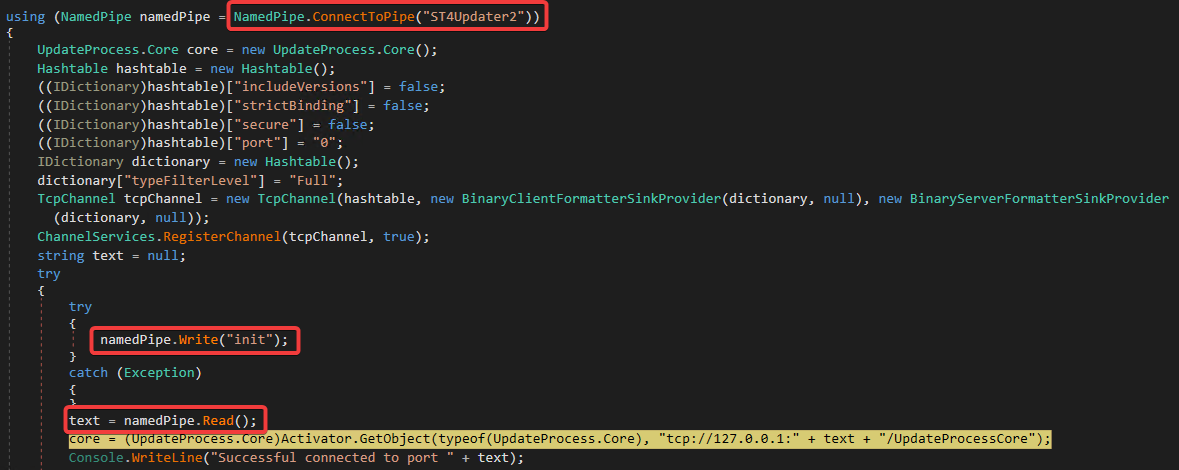
Figure 1: Proof of concept
Vulnerable / tested versions
The following version has been tested:
- 12.0.4.0 ST4 2022 SP4 (1d4a0bde) ??? SCHEMA ST4 12.4 build 2023.02.21-1d4a0bde
According to the vendor, all versions of SCHEMA ST4 on-premises are affected. The Cloud/SaaS deployments of SCHEMA ST4 are not affected. The Client Update Service has been removed in the cloud architecture according to the vendor.